Nancy Pearl, the book commentator on NPR, has a great claim to the title America's Librarian. Her "Booklust" radio columns are classics, and have been collected in two wonderful volumes. I discovered so many books in these classic book lists that I now read in Nancy Pearl's shadow.
A while ago Pearl conceived the brilliant idea of encouraging cities, through their public libraries, to choose a single book for all citizens to read. The concept, Pearl argued, was a tool to get all citizens, regardless of their differences, regularly to share at least one significant experience in common.
One Book One City has spread like wildfire.
Enter Jeff Howe, a contributing editor of Wired Magazine and author of Crowdsourcing, one of the great books of 2009. In Crowdsourcing Howe argues, in passing, that we are all now surrounded by very cheap, hyper-powerful, mobile, easy to learn and easy to use tools that put all of the world's knowledge in everyone's hands, robbing the schoolmaster of the power to distribute and control it. IMHO Crowdsourcing is one of the most important books for contemporary educators.
Howe argues in a post from April 23 2010 on his blog, also called Crowdsourcing, that because geography is no longer in the age of the Internet as salient a feature of group formation as is affinity, Pearl's One Book, One City concept is dated. With Global tools like Twitter the contemporary concept would be One Book One World.
With that grandiose vision, Howe has started a global book club, called One Book One Tweet, or #1b1t (note the Twitter hashtag). Yesterday's blog post spells out the rules for the discussion group on Twitter.
I am of the 'think globally act locally' school, and am hardly convinced that a global Twitter book club makes sense. Further, I think Pearl's project contributes to local community life in just the right way; it gives us something to talk about with our neighbors: our barbers, tree doctors and the folks we run into at the book store or cafe. Twitter keeps us home in front of the computer cut off from these folks.
I am, however, a pluralist and an optimist and I wish Howe's project well.
Friday, May 7, 2010


Thursday, May 6, 2010
" Bridging Differences" is Must Reading
Everyone reading this blog will gain insight by following the current dialogue between Diane Ravitch and Deborah Meier about Obama's Race to the Top initiative in their joint blog Bridging Differences.
The current discussion is about the "phony consensus" behind race to the Top, and the process by which the RTT money was alloactaed -- the end run around Congress.
I admit that I am not a huge Diane Ravitch fan, but I am learning much from this exchange.
The current discussion is about the "phony consensus" behind race to the Top, and the process by which the RTT money was alloactaed -- the end run around Congress.
I admit that I am not a huge Diane Ravitch fan, but I am learning much from this exchange.
Friday, April 30, 2010
Schools that Make a Difference: A Look at the League of Democratic Schools
(Cross-posted from the Journal of Educational Controversy Blog)

Several years ago, the Woodring College of Education at Western Washington University partnered with a local school, the Whatcom Day Academy, to be part of the League of Democratic Schools started by John Goodlad. Our partner school is now featured on the website of the Educational Institute for Democratic Renewal at Woodring, the institute that also houses the Journal of Educational Controversy. While the journal provides a format for a national and international exchange of ideas on important and controversial issues in education, our partnership allows us to put some of these ideas in practice and share them with others across the globe.
Recently, at a regional meeting of the League in Bend, Oregon, I was able to experience another school in the League, the Westside Village Magnet School. It is a wonderful example of a democratic progressive school and provides a model of what our schools can achieve. The first thing you notice when you first arrive at the school is the sense of activity all around you. The children are everywhere, and there is a sense of joy that permeates the building. Without the usual bells and teacher talk, the children just seem to know where they should be, something that they have internalized though the culture that the school has created.
A young boy walks up to me and introduces himself as Paul and shakes my hand as he welcomes me to the school. There is a sign in the library of the rights and responsibilities of the students, but it isn’t just the usual mission statements that one finds in schools. It is internalized in the students. We had arrived around noon and students were walking all around cleaning the school. We learned later that the multi-age school is broken into families that represent every level. For ten minutes each day, each family has an assigned set of chores that each student is responsible for. Other times groups are organized around interests.
CHILDREN DOING CHORES

We arrived too late to see the morning community meetings, but we were told that each day starts with different community meetings that are conducted by the children. Each age group has a chance to conduct the meeting and the students raise the issues that concern them.
There is also a peer mediation council made up of students where conflicts can be worked out. On this particular day, a video crew of volunteers from the community was videotaping the mediation process to show to other schools in the community who had requested more information about it. The children would role play a conflict (they played out an incident in the girl’s restroom today) and then take the conflict to the peer mediation council. The student mediators learn to use active listening, search for feelings as well as facts, paraphrase responses, and ask clarifying questions. The mediators then frame the situation, write up the issues and begin to discuss solutions. All discuss win/win solutions and continue to brainstorm until the conflicting students find a solution that they can both agree on. Both the role playing conflict and the mediation process were videotaped to show other schools how it works.
The school is organized around themes. The theme this year was on global issues. Each hub of multi-age student groups – broken into k-1, 2-3, 4-6, 7-8 or something like this – approach the themes at their own developmental level and in an interdisciplinary way. I visited a room where children were making masks. The criteria for the technical making of masks was posted on the wall along with two other sets of criteria – a Research Mask Criteria and a Mask Museum Display Card Criteria.
The artwork was easily connected with their research projects (the school is very inquiry-based) and the following criteria was used to guide the students with the creation of their masks on two dimensions other than just the technical criteria.
Research Mask Criteria:
1. Create a mask that represents the culture, living beings or environment impacted or affected by the issue.
2. Focus on a critical component /issue/solution from your research.
3. Personify your mask.
4. Exaggerate at least one feature.
5. Create Balance and unity.
6. Sketch your design first.
7. Follow Deb’s mask-making technique.
8. Adorn mask to enhance the message.
The third criteria that was posted on the wall dealt with a museum display of their work. Notice that many of their state standards that as a public school the school has to incorporate in its curriculum are easily integrated into this interdisciplinary approach.
Mask Museum Display Card Criteria:
1. Create a museum display card
2. Use a thought-provoking quote to inspire
3. Write a complete paragraph using a topic sentence that explains specific information from your research to support your opinions and conclusions.
4. Capture the reader’s interest.
5. Use descriptive language that includes adjectives, vivid verbs and adverbs.
6. Include a title.
7. Follow the writing process.
Many of the children had been studying the artwork of the Oregon artist, Betty LaDuke. The school places great emphasis on the arts and the creative process. As I wandered around the room watching the children draw and paint, I couldn’t resist asking them some questions. They very competently described their use of colors and patterns that they found in LaDuke’s paintings. The task was to create a painting that incorporated Betty LaDuke’s painting criteria. The assignment asked them to capture the essence of their research topic. They were also asked to share the people the topic mostly impacts, show how a change we might make would make a difference for our earth, capture the essence of the culture, include a theme, include a focal point, use vibrant, strong colors and repeated patterns, line and color (all reminiscent of LaDuke’s paintings), include people in the painting, and use Betty LaDuke’s folk art style. They were later to title it and mount it.
Drawings and paintings were all over the school and classroom walls -- most with a cultural and social theme. In fact, the social consciousness that the students exhibited was seamlessly intertwined with the academics and extracurricular activities.


We had arrived on a Friday which was a day for exploration. There were any number of classes going on from baking bread, repairing bikes, making mosaics, working in and exploring the garden and the streams, creating ceramics, engaging in drama, videotaping, and the Rise up for Nicaragua –sewing quilt. Again the social component was connected with the academic explorations in which the children were engaged. When a child read on the internet about “The Great American Bake Sale” to end childhood hunger in America, she brought the idea to her community meeting. As a result, one of the exploration activities was to learn to bake bread. The school has a huge oven in the garden where some thirty loaves could be made at one time. (It was tasty) The loaves were then donated to the poor and homeless in the community. The school also has its own greenhouse where the children are raising vegetables to give to the poor.
THE SCHOOL GARDEN

THE GREENHOUSE


THE OVEN


THE STREAM

One of the parents was working at the oven in the garden and I had a chance to chat with her. Of course, I asked why she sent her child to this school. At first, she mentioned the focus on individuality, creativity and community and then thought about the freedom from so much trivia she had seen in the two earlier schools that her child had attended – the obsession with gum chewing, wearing tank shirts, etc. Then after a few moments, she said, I guess it really comes down to the fact that this school respects children.
That mutual respect perhaps characterizes the school the best. There was so much more that I witnessed that I might share in a later blog posting. The school has a video on YouTube where you can see more. You can find it at: http://www.youtube.com/watch?v=kNS3GlHvVYM

Several years ago, the Woodring College of Education at Western Washington University partnered with a local school, the Whatcom Day Academy, to be part of the League of Democratic Schools started by John Goodlad. Our partner school is now featured on the website of the Educational Institute for Democratic Renewal at Woodring, the institute that also houses the Journal of Educational Controversy. While the journal provides a format for a national and international exchange of ideas on important and controversial issues in education, our partnership allows us to put some of these ideas in practice and share them with others across the globe.
Recently, at a regional meeting of the League in Bend, Oregon, I was able to experience another school in the League, the Westside Village Magnet School. It is a wonderful example of a democratic progressive school and provides a model of what our schools can achieve. The first thing you notice when you first arrive at the school is the sense of activity all around you. The children are everywhere, and there is a sense of joy that permeates the building. Without the usual bells and teacher talk, the children just seem to know where they should be, something that they have internalized though the culture that the school has created.
A young boy walks up to me and introduces himself as Paul and shakes my hand as he welcomes me to the school. There is a sign in the library of the rights and responsibilities of the students, but it isn’t just the usual mission statements that one finds in schools. It is internalized in the students. We had arrived around noon and students were walking all around cleaning the school. We learned later that the multi-age school is broken into families that represent every level. For ten minutes each day, each family has an assigned set of chores that each student is responsible for. Other times groups are organized around interests.
CHILDREN DOING CHORES

We arrived too late to see the morning community meetings, but we were told that each day starts with different community meetings that are conducted by the children. Each age group has a chance to conduct the meeting and the students raise the issues that concern them.

There is also a peer mediation council made up of students where conflicts can be worked out. On this particular day, a video crew of volunteers from the community was videotaping the mediation process to show to other schools in the community who had requested more information about it. The children would role play a conflict (they played out an incident in the girl’s restroom today) and then take the conflict to the peer mediation council. The student mediators learn to use active listening, search for feelings as well as facts, paraphrase responses, and ask clarifying questions. The mediators then frame the situation, write up the issues and begin to discuss solutions. All discuss win/win solutions and continue to brainstorm until the conflicting students find a solution that they can both agree on. Both the role playing conflict and the mediation process were videotaped to show other schools how it works.
The school is organized around themes. The theme this year was on global issues. Each hub of multi-age student groups – broken into k-1, 2-3, 4-6, 7-8 or something like this – approach the themes at their own developmental level and in an interdisciplinary way. I visited a room where children were making masks. The criteria for the technical making of masks was posted on the wall along with two other sets of criteria – a Research Mask Criteria and a Mask Museum Display Card Criteria.
The artwork was easily connected with their research projects (the school is very inquiry-based) and the following criteria was used to guide the students with the creation of their masks on two dimensions other than just the technical criteria.
Research Mask Criteria:
1. Create a mask that represents the culture, living beings or environment impacted or affected by the issue.
2. Focus on a critical component /issue/solution from your research.
3. Personify your mask.
4. Exaggerate at least one feature.
5. Create Balance and unity.
6. Sketch your design first.
7. Follow Deb’s mask-making technique.
8. Adorn mask to enhance the message.
The third criteria that was posted on the wall dealt with a museum display of their work. Notice that many of their state standards that as a public school the school has to incorporate in its curriculum are easily integrated into this interdisciplinary approach.
Mask Museum Display Card Criteria:
1. Create a museum display card
2. Use a thought-provoking quote to inspire
3. Write a complete paragraph using a topic sentence that explains specific information from your research to support your opinions and conclusions.
4. Capture the reader’s interest.
5. Use descriptive language that includes adjectives, vivid verbs and adverbs.
6. Include a title.
7. Follow the writing process.
Many of the children had been studying the artwork of the Oregon artist, Betty LaDuke. The school places great emphasis on the arts and the creative process. As I wandered around the room watching the children draw and paint, I couldn’t resist asking them some questions. They very competently described their use of colors and patterns that they found in LaDuke’s paintings. The task was to create a painting that incorporated Betty LaDuke’s painting criteria. The assignment asked them to capture the essence of their research topic. They were also asked to share the people the topic mostly impacts, show how a change we might make would make a difference for our earth, capture the essence of the culture, include a theme, include a focal point, use vibrant, strong colors and repeated patterns, line and color (all reminiscent of LaDuke’s paintings), include people in the painting, and use Betty LaDuke’s folk art style. They were later to title it and mount it.
Drawings and paintings were all over the school and classroom walls -- most with a cultural and social theme. In fact, the social consciousness that the students exhibited was seamlessly intertwined with the academics and extracurricular activities.


We had arrived on a Friday which was a day for exploration. There were any number of classes going on from baking bread, repairing bikes, making mosaics, working in and exploring the garden and the streams, creating ceramics, engaging in drama, videotaping, and the Rise up for Nicaragua –sewing quilt. Again the social component was connected with the academic explorations in which the children were engaged. When a child read on the internet about “The Great American Bake Sale” to end childhood hunger in America, she brought the idea to her community meeting. As a result, one of the exploration activities was to learn to bake bread. The school has a huge oven in the garden where some thirty loaves could be made at one time. (It was tasty) The loaves were then donated to the poor and homeless in the community. The school also has its own greenhouse where the children are raising vegetables to give to the poor.
THE SCHOOL GARDEN

THE GREENHOUSE


THE OVEN


THE STREAM

One of the parents was working at the oven in the garden and I had a chance to chat with her. Of course, I asked why she sent her child to this school. At first, she mentioned the focus on individuality, creativity and community and then thought about the freedom from so much trivia she had seen in the two earlier schools that her child had attended – the obsession with gum chewing, wearing tank shirts, etc. Then after a few moments, she said, I guess it really comes down to the fact that this school respects children.
That mutual respect perhaps characterizes the school the best. There was so much more that I witnessed that I might share in a later blog posting. The school has a video on YouTube where you can see more. You can find it at: http://www.youtube.com/watch?v=kNS3GlHvVYM
Of course, the question that many of you probably want to ask is the question about children’s achievement and test scores in this kind of environment. Well, the school is high achieving. It reminds me of something that John Dewey always said – that one does not necessarily hit the goal by directly aiming at it. Once of the sad consequences of the current reform and its obsession with a standardized test score is the elimination of everything that makes learning and life worthwhile – the arts, music, dance, drama, physical development, etc. It is one of those unintended consequences of the policies we construct. But as Dewey always reminded us, when our curriculum is embedded in meaningful activities, when it has a function other than achieving a test score, children not only ironically achieve but also learn to love to learn. After all, as Dewey would say, education is life not just a preparation for life.
The next issue of the Journal of Educational Controversy will focus on the theme, “The Education and Schools our Children Deserve,” and we will be featuring articles, ideas, and video from other League schools. Susan Donnelly, the head of the Whatcom Day Academy, the school we partner with in the League, will co-edit the issue. Our hope is to provide a vision of what our schools can be.
The next issue of the Journal of Educational Controversy will focus on the theme, “The Education and Schools our Children Deserve,” and we will be featuring articles, ideas, and video from other League schools. Susan Donnelly, the head of the Whatcom Day Academy, the school we partner with in the League, will co-edit the issue. Our hope is to provide a vision of what our schools can be.
Monday, March 29, 2010
Building a Better Teacher: Get out your Manual
I recently read a New York Times magazine article called “Building a Better Teacher” by Elizabeth Green. It was informative in its way, but the piece as a whole really left a lot to be desired. It was technicist and very narrow in its approach to thinking about what teaching is, who students are, and how one learns teaching as a craft. That Green is a Spencer Fellow in education made this fact all the more depressing.
The article provides a very good look at the current concerns over inadequate supplies of highly-qualified, effective teachers. Green examines various efforts to understand and document the work of such teachers, and to explain these efforts to NYT readers. She documents the work of people such as Doug Lemov, a former teacher, principal and charter-school founder who has developed a personal mission: to develop a deep knowledge of excellent teaching and to pass that knowledge along to those in the teaching profession. Lemov’s Taxonomy is what came out of this mission, and a book about it will come out soon called Teach Like a Champion: The 49 Techniques That Put Students on the Path to College. Green also documents the work emerging out of places like Michigan State University and other places who have focused hard on high quality research and teaching about the work of teaching.
The work to better understand the work of excellent teachers is noble. For those who care about issues of equity and democracy – as many readers of this blog do – there is little more paramount than the work of teaching teachers. No other variable matters more in helping kids from poor and racially-isolated neighborhoods to experience academic success. And there is an awful lot we do not know or understand about how to develop, coach and assess excellent teaching.
But Green’s article confuses teaching technique with the larger philosophical, moral, political, and pedagogical work of educating young people. Green does a disservice to not only the craft of teaching and learning how to teach in schools, but in the process also advances the agenda of those bashing schools of education and teacher education program. She seems eager to buy into Art Levine’s 2006 assessment of teacher education as a scattered and ineffective course of study. Certainly there are a lot of bad teacher education programs out there, and each program needs to be judged and held accountable for its own flaws and problems. But Green’s criticisms are much more general lobs at schools of education as a whole, and thus do not see any of the differences in quality among programs and schools. Even Green’s characterization of the course of study for most teachers in university teacher education programs doesn’t even seem accurate:
[I am among that horrifying 12 percent of professors in education schools who have never taught in elementary or secondary schools. Honestly, what can I be thinking? How can I know anything about teaching by studying it, researching it, practicing it, and committing my professional life to learning and teaching others about it? Not much, is the implication here.]
Green also gives a brief historical look at how normal schools became schools of education at modern universities:
Technique is important, but it is always the means to an end. What “end” does any teaching technique serve, and is that end a laudable goal? If teachers cannot answer this larger question, then they are merely following a manual. Teachers must know how to teach – I know of no one in my school of education who argues otherwise – but one should not confuse the techniques of teaching with the craft of teaching. Craft is part art, part science; it is a moral endeavor that cannot be simplistically reduced to a list of techniques for people to follow after they’ve learned the content of math, history, or English literature. I doubt that Green, a Spencer fellow, understands teaching in this simplistic way. Unfortunately, her article leaves exactly that impression.
The article provides a very good look at the current concerns over inadequate supplies of highly-qualified, effective teachers. Green examines various efforts to understand and document the work of such teachers, and to explain these efforts to NYT readers. She documents the work of people such as Doug Lemov, a former teacher, principal and charter-school founder who has developed a personal mission: to develop a deep knowledge of excellent teaching and to pass that knowledge along to those in the teaching profession. Lemov’s Taxonomy is what came out of this mission, and a book about it will come out soon called Teach Like a Champion: The 49 Techniques That Put Students on the Path to College. Green also documents the work emerging out of places like Michigan State University and other places who have focused hard on high quality research and teaching about the work of teaching.
The work to better understand the work of excellent teachers is noble. For those who care about issues of equity and democracy – as many readers of this blog do – there is little more paramount than the work of teaching teachers. No other variable matters more in helping kids from poor and racially-isolated neighborhoods to experience academic success. And there is an awful lot we do not know or understand about how to develop, coach and assess excellent teaching.
But Green’s article confuses teaching technique with the larger philosophical, moral, political, and pedagogical work of educating young people. Green does a disservice to not only the craft of teaching and learning how to teach in schools, but in the process also advances the agenda of those bashing schools of education and teacher education program. She seems eager to buy into Art Levine’s 2006 assessment of teacher education as a scattered and ineffective course of study. Certainly there are a lot of bad teacher education programs out there, and each program needs to be judged and held accountable for its own flaws and problems. But Green’s criticisms are much more general lobs at schools of education as a whole, and thus do not see any of the differences in quality among programs and schools. Even Green’s characterization of the course of study for most teachers in university teacher education programs doesn’t even seem accurate:
Traditionally, education schools divide their curriculums into three parts: regular academic subjects, to make sure teachers know the basics of what they are assigned to teach; “foundations” courses that give them a sense of the history and philosophy of education; and finally “methods” courses that are supposed to offer ideas for how to teach particular subjects. Many schools add a required stint as a student teacher in a more-experienced teacher’s class. Yet schools can’t always control for the quality of the experienced teacher, and education-school professors often have little contact with actual schools. A 2006 report found that 12 percent of education-school faculty members never taught in elementary or secondary schools themselves. Even some methods professors have never set foot in a classroom or have not done so recently.Three points strike me about this excerpt. One, this description leaves out the role of the liberal arts curriculum. At my institution and others, the liberal arts is seen as playing an important role in teaching critical thinking, communication, and inquiry, all essential skills for great teaching. The second problem with Green’s account here is that it over-states the foundations element and the role it plays today. At my university (a public, selective state institution enrolling around 14,000 undergraduates), out of an approximately 128 credit hour teacher education degree, the foundations requirement takes up exactly three of those credit hours, constituting about 2% of the total learning (if credits could be equated to learning, which they can’t). And the third problem with this excerpt is that it’s confused. If 88 percent of education faculty school professors have taught in schools, isn’t the accusation that they are “out of touch” with real schools a bit hard to claim?
[I am among that horrifying 12 percent of professors in education schools who have never taught in elementary or secondary schools. Honestly, what can I be thinking? How can I know anything about teaching by studying it, researching it, practicing it, and committing my professional life to learning and teaching others about it? Not much, is the implication here.]
Green also gives a brief historical look at how normal schools became schools of education at modern universities:
In the 20th century, as normal schools were brought under the umbrella of the modern university, other imperatives took over. Measured against the glamorous fields of history, economics and psychology, classroom technique began to look downright mundane. Many education professors adopted the tools of social science and took on schools as their subject. Others flew the banner of progressivism or its contemporary cousin constructivism: a theory of learning that emphasizes the importance of students’ taking ownership of their own work above all else.Green is right that schools of education have long suffered status problems, and have responded in various ways that were not always in the bests interest of schools or children. One wonders, however, what might be the problem with using social science to better understand how schools work or function as social systems. One also wonders where Green learned about progressivism. Not even progressivism’s worst enemies would sum it up in the dismissive way that she does here.
Technique is important, but it is always the means to an end. What “end” does any teaching technique serve, and is that end a laudable goal? If teachers cannot answer this larger question, then they are merely following a manual. Teachers must know how to teach – I know of no one in my school of education who argues otherwise – but one should not confuse the techniques of teaching with the craft of teaching. Craft is part art, part science; it is a moral endeavor that cannot be simplistically reduced to a list of techniques for people to follow after they’ve learned the content of math, history, or English literature. I doubt that Green, a Spencer fellow, understands teaching in this simplistic way. Unfortunately, her article leaves exactly that impression.
Sunday, March 28, 2010
Schooling as if Democracy Matters
(cross-posted from the Journal of Educational Controversy blog)
The focus of our Winter 2008 issue of the Journal of Educational Controversy was on the topic, “Schooling as if Democracy Matters.” In that issue, we raised the question about the ways we should teach the young about the foundations of our democracy and our collective identity in an age of the patriot act, NSA surveillance, extraordinary rendition, preemptive wars, enemy combatants -- all likely to involve violations of civil rights and liberties and a curtain of government secrecy? We asked, what story do we tell our young about who we are, who we have been, and who we are becoming?
I’d like to raise this same question in light of today’s events. In an interesting NY Times op-ed article, “The Rage Is Not About Health Care,” Frank Rich talks about some of the underlying reasons for the rise in rage, venomous rhetoric, violence, and anxieties in today’s demonstrations against the recently adopted health care bill. Comparing the bill’s passage to earlier bills that shook the country – the Medicare Act of 1965 and the Social Security Act of 1935, Rich describes the rhetoric and the upheavals that these bills also caused. But the bill that comes closest to the type of vitriolic criticism that today’s bill is evoking, Rich argues, is the Civil Rights Bill of 1964.
This may sound like a strange claim given that the present Health Care bill actually contains many of the recommendations of the Republican Party, falling far short of the single payer system or public option plan that more liberal proponents advocated. Rather than a “government takeover,” it extends the free market’s involvement in health care. While there are legitimate arguments over health care entitlement, the type of reaction we are experiencing seems to be disproportionate. Rich argues that the health care bill is just a spark that is galvanizing anxieties at a deeper level.
He offers the following explanation for today’s rising tide of rage:
The health care bill is not the main source of this anger and never has been. It’s merely a handy excuse. The real source of the over-the-top rage of 2010 is the same kind of national existential reordering that roiled America in 1964.
In fact, the current surge of anger — and the accompanying rise in right-wing extremism — predates the entire health care debate. The first signs were the shrieks of “traitor” and “off with his head” at Palin rallies as Obama’s election became more likely in October 2008. Those passions have spiraled ever since — from Gov. Rick Perry’s kowtowing to secessionists at a Tea Party rally in Texas to the gratuitous brandishing of assault weapons at Obama health care rallies last summer to “You lie!” piercing the president’s address to Congress last fall like an ominous shot.
If Obama’s first legislative priority had been immigration or financial reform or climate change, we would have seen the same trajectory. The conjunction of a black president and a female speaker of the House — topped off by a wise Latina on the Supreme Court and a powerful gay Congressional committee chairman — would sow fears of disenfranchisement among a dwindling and threatened minority in the country no matter what policies were in play. It’s not happenstance that Frank, Lewis and Cleaver — none of them major Democratic players in the health care push — received a major share of last weekend’s abuse. When you hear demonstrators chant the slogan “Take our country back!,” these are the people they want to take the country back from.
They can’t. Demographics are avatars of a change bigger than any bill contemplated by Obama or Congress. The week before the health care vote, The Times reported that births to Asian, black and Hispanic women accounted for 48 percent of all births in America in the 12 months ending in July 2008. By 2012, the next presidential election year, non-Hispanic white births will be in the minority. The Tea Party movement is virtually all white. The Republicans haven’t had a single African-American in the Senate or the House since 2003 and have had only three in total since 1935. Their anxieties about a rapidly changing America are well-grounded. (The New York Times, March 27, 2010)
Rich notes that there were some responsible leaders of both parties who tried to put a lid on the resistance and violence that took place after the passage of the Civil Rights Act of 1964, unlike the silence coming from the lack of leadership among today’s political leaders, who often tend to exploit the anxieties instead.
Both the 1964 and 2010 bills have become the catalyst for shaking the nation’s core understanding of itself. And this leaves us with the question with which I began this post. What is the responsibility of our teachers and public intellectuals for addressing these deeper issues in the classrooms and in the public square. We hope to address these more profound questions in our summer 2011 issue of the journal on “The Education our Children Deserve.”
The focus of our Winter 2008 issue of the Journal of Educational Controversy was on the topic, “Schooling as if Democracy Matters.” In that issue, we raised the question about the ways we should teach the young about the foundations of our democracy and our collective identity in an age of the patriot act, NSA surveillance, extraordinary rendition, preemptive wars, enemy combatants -- all likely to involve violations of civil rights and liberties and a curtain of government secrecy? We asked, what story do we tell our young about who we are, who we have been, and who we are becoming?
I’d like to raise this same question in light of today’s events. In an interesting NY Times op-ed article, “The Rage Is Not About Health Care,” Frank Rich talks about some of the underlying reasons for the rise in rage, venomous rhetoric, violence, and anxieties in today’s demonstrations against the recently adopted health care bill. Comparing the bill’s passage to earlier bills that shook the country – the Medicare Act of 1965 and the Social Security Act of 1935, Rich describes the rhetoric and the upheavals that these bills also caused. But the bill that comes closest to the type of vitriolic criticism that today’s bill is evoking, Rich argues, is the Civil Rights Bill of 1964.
This may sound like a strange claim given that the present Health Care bill actually contains many of the recommendations of the Republican Party, falling far short of the single payer system or public option plan that more liberal proponents advocated. Rather than a “government takeover,” it extends the free market’s involvement in health care. While there are legitimate arguments over health care entitlement, the type of reaction we are experiencing seems to be disproportionate. Rich argues that the health care bill is just a spark that is galvanizing anxieties at a deeper level.
He offers the following explanation for today’s rising tide of rage:
The health care bill is not the main source of this anger and never has been. It’s merely a handy excuse. The real source of the over-the-top rage of 2010 is the same kind of national existential reordering that roiled America in 1964.
In fact, the current surge of anger — and the accompanying rise in right-wing extremism — predates the entire health care debate. The first signs were the shrieks of “traitor” and “off with his head” at Palin rallies as Obama’s election became more likely in October 2008. Those passions have spiraled ever since — from Gov. Rick Perry’s kowtowing to secessionists at a Tea Party rally in Texas to the gratuitous brandishing of assault weapons at Obama health care rallies last summer to “You lie!” piercing the president’s address to Congress last fall like an ominous shot.
If Obama’s first legislative priority had been immigration or financial reform or climate change, we would have seen the same trajectory. The conjunction of a black president and a female speaker of the House — topped off by a wise Latina on the Supreme Court and a powerful gay Congressional committee chairman — would sow fears of disenfranchisement among a dwindling and threatened minority in the country no matter what policies were in play. It’s not happenstance that Frank, Lewis and Cleaver — none of them major Democratic players in the health care push — received a major share of last weekend’s abuse. When you hear demonstrators chant the slogan “Take our country back!,” these are the people they want to take the country back from.
They can’t. Demographics are avatars of a change bigger than any bill contemplated by Obama or Congress. The week before the health care vote, The Times reported that births to Asian, black and Hispanic women accounted for 48 percent of all births in America in the 12 months ending in July 2008. By 2012, the next presidential election year, non-Hispanic white births will be in the minority. The Tea Party movement is virtually all white. The Republicans haven’t had a single African-American in the Senate or the House since 2003 and have had only three in total since 1935. Their anxieties about a rapidly changing America are well-grounded. (The New York Times, March 27, 2010)
Rich notes that there were some responsible leaders of both parties who tried to put a lid on the resistance and violence that took place after the passage of the Civil Rights Act of 1964, unlike the silence coming from the lack of leadership among today’s political leaders, who often tend to exploit the anxieties instead.
Both the 1964 and 2010 bills have become the catalyst for shaking the nation’s core understanding of itself. And this leaves us with the question with which I began this post. What is the responsibility of our teachers and public intellectuals for addressing these deeper issues in the classrooms and in the public square. We hope to address these more profound questions in our summer 2011 issue of the journal on “The Education our Children Deserve.”
Saturday, March 13, 2010
Stealth Philanthrocapitalism? New World Bank "Game" Raises Concerns
A few days ago, a friend of mine sent me a link to a educational web based "computer game" called Urgent: Evoke. The game is produced by the World Bank's educational arm, the World Bank Institute. I've always been interested in the pedagogical potential of computer games, so I decided to check it out.
The first thing that struck me was that Urgent: Evoke is not actually a computer game, at least not in the conventional sense of the term. Computer games usually immerse the player in some sort of virtual world; Urgent: Evoke does not do this (or, at least, it certainly doesn't do it effectively). Instead, Urgent: Evoke draws students' attention to current social problems and offers them points for completing "missions" that are focused on analyzing and solving these problems. In short, Urgent: Evoke isn't a computer game at all. It's a web based curriculum with a reward scheme attached to it.
This highlights another important question: if Urgent: Evoke is a web-based curriculum, what are its intended goals? Ostensibly, Urgent: Evoke is supposed to raise awareness of social problems and galvanize students to work toward solutions. However, a quick inspection of the "game" reveals that the purpose of the game is to extol the virtues of a variety of philanthrocapitalism called "social entrepreneurship." Philanthrocapitalism, to put it bluntly, is basically the idea that one can do good and promote capitalist solutions at the same time.
The curriculum opens with a cartoon that introduces students to the Urgent: Evoke team. In the first episode of the cartoon, the team, a group of technocratic superheroes, is preparing to swoop in to solve a food shortage that is facing Tokyo (you can click on the cartoons for a closer look).

 In this panel, one of the social change superheroes is talking on his cellphone. He comments, "I think we'd better move fast before someone else corners the market in Tokyo." He adds, "...once we show the world the enterprise potential, we'll be fighting for a slice." This food shortage is a social problem with moneymaking possibilities!
This conversation is continued in the next panel:

As our World Bank hero gets ready to climb into his helicopter, he remarks, "Feed the people, clean the air, cool the climate...and make a few dollars in the process." The social entrepreneurship dream is thus nicely summed up.
After the students are finished reading the first episode of the cartoon, they are invited to join the Urgent: Evoke "team" and complete a series of "missions." In the first mission, the students are assigned to discover the "secrets of social innovation." The 33 secrets include the following notable insights:
Tip #3: Embrace market mechanisms (Giving stuff away rarely works as well as selling it.)
Tip #19: Think like a child. Children have no limit to their thinking.
Tip #26: Keep learning from your customers.
Once they have mastered these recondite secrets of social change, the students are assigned to choose a real-life "social innovation hero" to shadow. Shadowing, in this instance, means following the "hero" on Twitter or friending them on Facebook. The student could, for example, choose to shadow Nigel Waller, who heroically sells cellular phones to people who earn less than $2/day.
Once the students have learned the necessary lessons from the first episode, they can check out the second episode of the cartoon, in which our Urgent: Evoke social change heroes save Tokyo. Naturally, being technocrats, they do this without the knowledge of the hidebound locals (see panel below):
 The governor of Tokyo doesn't know what our heroes are up to, but that's no problem. That's just the way that social innovation works!
 In the panel above, the leader of the Urgent: Evoke team responds to the governor's concerns, "We like our secrets, Mr. Governor. Our strategy is not up for negotiation. Secret is how we work." Obviously, it doesn't matter whether one wants social entrepreneurship--it's coming anyway!
After the heroes have saved Tokyo, the student is prompted to learn more about food security. They can, for example, learn about how the One Acre Fund is helping farmers in Africa. This organization is strongly committed to philanthrocapitalism. The website proclaims, "We don’t hand out—we empower farmers with tools, and they pay us back." Remember secret #3 of how to create social change: don't give things away--embrace market mechanisms! The tools which are provided include encouraging farmers to grow more lucrative cash crops as well as providing them with hybrid seed (which cannot be reproduced) and fertilizer.
The ideology behind this curriculum is crystal clear, and no one should be shocked that it is the World Bank that has created it. The head of the World Bank, Robert Zoellick, is a George W. Bush appointee and a former Goldman-Sachs investment banker. For the World Bank, capitalism isn't the problem--it's the solution.
As far as the idea of philanthrocapitalism itself is concerned, I have serious doubts. I am always reminded of the following scene in Dickens' Nicholas Nickleby, in which the schoolmasters, Mr. and Mrs. Squeers, are doling out doses of brimstone to their unfortunate students:
Notably, as educators, we can turn to our own tradition for criticism of philanthrocapitalism. In Pedagogy of the Oppressed, Freire wrote about false generosity. The falsely generous person, Freire claimed, tries to ameliorate the problems of the poor while simultaneously upholding the unjust social system. Philanthrocapitalism is simply the latest variation on this old theme.
Update: there's a great parody of the game at Urgent: Invoke. Check it out!
The first thing that struck me was that Urgent: Evoke is not actually a computer game, at least not in the conventional sense of the term. Computer games usually immerse the player in some sort of virtual world; Urgent: Evoke does not do this (or, at least, it certainly doesn't do it effectively). Instead, Urgent: Evoke draws students' attention to current social problems and offers them points for completing "missions" that are focused on analyzing and solving these problems. In short, Urgent: Evoke isn't a computer game at all. It's a web based curriculum with a reward scheme attached to it.
This highlights another important question: if Urgent: Evoke is a web-based curriculum, what are its intended goals? Ostensibly, Urgent: Evoke is supposed to raise awareness of social problems and galvanize students to work toward solutions. However, a quick inspection of the "game" reveals that the purpose of the game is to extol the virtues of a variety of philanthrocapitalism called "social entrepreneurship." Philanthrocapitalism, to put it bluntly, is basically the idea that one can do good and promote capitalist solutions at the same time.
The curriculum opens with a cartoon that introduces students to the Urgent: Evoke team. In the first episode of the cartoon, the team, a group of technocratic superheroes, is preparing to swoop in to solve a food shortage that is facing Tokyo (you can click on the cartoons for a closer look).
 In this panel, one of the social change superheroes is talking on his cellphone. He comments, "I think we'd better move fast before someone else corners the market in Tokyo." He adds, "...once we show the world the enterprise potential, we'll be fighting for a slice." This food shortage is a social problem with moneymaking possibilities!
This conversation is continued in the next panel:

As our World Bank hero gets ready to climb into his helicopter, he remarks, "Feed the people, clean the air, cool the climate...and make a few dollars in the process." The social entrepreneurship dream is thus nicely summed up.
After the students are finished reading the first episode of the cartoon, they are invited to join the Urgent: Evoke "team" and complete a series of "missions." In the first mission, the students are assigned to discover the "secrets of social innovation." The 33 secrets include the following notable insights:
Tip #3: Embrace market mechanisms (Giving stuff away rarely works as well as selling it.)
Tip #19: Think like a child. Children have no limit to their thinking.
Tip #26: Keep learning from your customers.
Once they have mastered these recondite secrets of social change, the students are assigned to choose a real-life "social innovation hero" to shadow. Shadowing, in this instance, means following the "hero" on Twitter or friending them on Facebook. The student could, for example, choose to shadow Nigel Waller, who heroically sells cellular phones to people who earn less than $2/day.
Once the students have learned the necessary lessons from the first episode, they can check out the second episode of the cartoon, in which our Urgent: Evoke social change heroes save Tokyo. Naturally, being technocrats, they do this without the knowledge of the hidebound locals (see panel below):
 The governor of Tokyo doesn't know what our heroes are up to, but that's no problem. That's just the way that social innovation works!
 In the panel above, the leader of the Urgent: Evoke team responds to the governor's concerns, "We like our secrets, Mr. Governor. Our strategy is not up for negotiation. Secret is how we work." Obviously, it doesn't matter whether one wants social entrepreneurship--it's coming anyway!
After the heroes have saved Tokyo, the student is prompted to learn more about food security. They can, for example, learn about how the One Acre Fund is helping farmers in Africa. This organization is strongly committed to philanthrocapitalism. The website proclaims, "We don’t hand out—we empower farmers with tools, and they pay us back." Remember secret #3 of how to create social change: don't give things away--embrace market mechanisms! The tools which are provided include encouraging farmers to grow more lucrative cash crops as well as providing them with hybrid seed (which cannot be reproduced) and fertilizer.
The ideology behind this curriculum is crystal clear, and no one should be shocked that it is the World Bank that has created it. The head of the World Bank, Robert Zoellick, is a George W. Bush appointee and a former Goldman-Sachs investment banker. For the World Bank, capitalism isn't the problem--it's the solution.
As far as the idea of philanthrocapitalism itself is concerned, I have serious doubts. I am always reminded of the following scene in Dickens' Nicholas Nickleby, in which the schoolmasters, Mr. and Mrs. Squeers, are doling out doses of brimstone to their unfortunate students:
Mrs. Squeers was stationed at one end of the room, where she was feeding out brimstone and treacle to each boy in turn. "Medicates 'em," said Squeers. "Rot!" said Mrs. Squeers. "It takes away their appetites, and that's good for us. It purifies their blood, and I hope that's good for them."Philanthrocapitalism is supposed to provide a sunnier version of this kind of win-win, good-for-us/good-for-them situation. But does it really? In a review of Michael Edwards' new book, Small Change: Why Business Won't Save the World, authors Mark Engler and Arthur Phillips explain some of the shortcomings of this idea. Even in its more palatable forms (e.g. where the philanthrocapitalist is not trying to make money him/herself), philanthrocapitalism does little to question the system that, arguably, produced many of the social disparities that it is supposed to address.
Notably, as educators, we can turn to our own tradition for criticism of philanthrocapitalism. In Pedagogy of the Oppressed, Freire wrote about false generosity. The falsely generous person, Freire claimed, tries to ameliorate the problems of the poor while simultaneously upholding the unjust social system. Philanthrocapitalism is simply the latest variation on this old theme.
Update: there's a great parody of the game at Urgent: Invoke. Check it out!
Thursday, February 18, 2010
Who should select school principals in Chicago?

In the Chicago Public Schools, since 1988, school principals have been hired (for five year contracts) and fired by the Local School Council (LSC), an elected body of parents, community members, and teachers that also approves each year's school budget (within some limits imposed by the central office).
A new bill in the Illinois legislature, sponsored by Chicago democrat (and minister) James Meeks, would shift the principal-selection power away from the LSC, returning it to the central office (and thus, the ultimate control of the mayor). Some progressive groups are complaining that this is an affront to the ideals of democracy.
"Why would he want to get rid of the last segment of democracy that exists in our schools, where people who are most directly affected can have a voice in how their schools are run?'' asked Jitu Brown of the Kenwood Oakland Community Organization. (from the Sun-Times article; see also this Tribune article)I have mixed feelings about this one. Besides being democratically elected, do LSCs offer any special insights that give them a better perspective from which to appoint principals? We don't elect the civil engineers who oversee the building of bridges and other critical public infrastructure democratically. Rather, we expect the selection of civil engineers to be determined in accordance with professional standards of expertise. Certainly at some level this selection process is shaped by the democratic process, because the ultimate executive powers overseeing their selection are subjected to democratic elections. But we expect the selection process itself to be shielded from political considerations such as popularity, ability to raise funds, or the appeal of an Irish last name.
 Nor do we elect our military leaders. As the Athenians had learned during the Peloponnesian War, military generals need to be able to make military decisions without regard to their personal popularity or appeal to populous impulses. (Of course, the Commander-in-Chief is elected in the US, which of course sometimes results in military decisions that seem designed to shore up popular support for the regime.) Other professions in which popular election seems unwise (and is rarely seen) include university professors, corporate CEOs, and scientists.
 The most common way to select school principals in the US is appointment by a superintendent, who is in turn appointed by an elected school board. Yes, we do, in the US, largely follow the practice of electing school boards. This practice with long historical roots in the way that schools were first established in the US, village by village, and the gradual move toward financing those schools increasingly out of local property taxes (thus justifying the notion that their functioning should be subject to periodic public approval).
 The key question, I think, that should be asked about how various professionals should be selected (appointed or elected) is the relative balance that the job requires between sensitivity to public desires (elect them) and professonal expertise (appoint them). Amy Gutmann does a nice job of discussing this balance in a section entitled "Democratic Professionalism" in her widely respected book, Democratic Education. She writes that democratic local control of schools has the positive effect of permitting "educational content to vary, as it should, with local circumstances and local democratic preferences," and also ensures local public support of school policies. In addition, local elections of school boards provides a place for individual citizens and local groups to gain experience with active participation in governance (p. 74). The downsides of local control (most importantly, the possibility of tyrannical or corrupt policies) are minimized by both the public's access to school board decisions (if nothing else, people hear about it from their children) and by the on-the-ground presence of teachers, who have their own professional expertise and can, through their unions especially, raise a stink about what they see as bad policies. This balance, Guttmann believes, helps to ensure that schools foster in students not just compliance to majority-supported behavioral and ideological standards, but also (we can only hope!) critical awareness.
  In the early decades of the 20th century, the progressive movement worked to replace multiple school boards elected within each neighborhood (and often influenced heavily by local political heavyweights) with more centralized elected boards, especially in larger cities. The power of the elected boards was also moderated by requiring boards to appoint an experienced professional educator as superintendent. (In some states such as Alabama, school boards can only act with the recommendation of the superintendent.) This centralizing reform carried over to rural districts with the policy of district consolidation that prevailed in the 1950s and 60s, and the power of school boards has also been limited by the gradual assumption of power over local education by the federal government (and by the states as well) in the decades since. In a sense, then, Chicago's return in 1988 to the election of local school councils with control over each schools' budget and the hiring and firing of principals is a return to earlier conditions. The justification for that return to an earlier tradition was two-fold. First, Chicago's schools were so terrible (called "worst in the nation" by then US Secretary of Education, William Bennett), that decentralizing control of the schools couldn't make them any worse. Second, the move reflected the growing power of minority groups in Chicago city politics, many of whom felt ill-served by the decisions of a largely white, largely high SES central school board. The actual effect of the change has been mixed, although most observers suggest that many school improvements can be traced to the wisdom of LSCs that make appropriate decisions in light of the unique circumstances of each school.
  In general, the tradition of local control of schools through elected school boards has had mixed effects over the years, and even the idea of that they are democratically elected can be questioned in light of extremely low voter turnout in most school board elections. In some areas, elected school boards include people who are elected on a single issue, such as the goal of restoring creationism to the curriculum. The tradition of elected school boards has also recently come under attack (at least with regard to large urban districts) from some conservative educational critics (e.g. Chubb & Moe, and Checker Finn), as well as US Secretary of Education Arne Duncan, a supposed progressive who believes that such districts need "leadership from the top." Duncan has cited his seven-year experience as CEO of the Chicago Public Schools, where the school board has, since 1992, been appointed by the mayor, rather than elected, as evidence that appointed boards are less likely than elected ones to shuffle school leadership for political purposes. But as Jim Horn has pointed out, Duncan's call for appointed school boards only extends to those large urban districts where schools seem most devoted to creating compliance among poor and minority children (rather than learning), and not to the pretty successful suburban districts where elected school boards retain the general support of most of the voting public.
Truly, the election of Local School Councils represents one of very few examples of neighborhood control of urban public institutions anywhere, and (at least according to some research summarized by Designs for Change, a local progressive advocacy group) the majority of the 600+ LSCs actually work fairly well. (Of course, this conclusion depends upon agreeing that have 10-15% of schools in the city with "LSCs ... enmeshed in sustained conflict, ...inactive, or hav[ing] engaged in unethical behavior" -- that's 60 - 90 schools, by the way -- is okay.
 It is those 10-15% of LSCs (more or less) that aren't functioning well that are the primary targets of Meek's proposed legislation. The schools with these LSCs are generally awful by any measure, and tend to be in neighborhoods with limited local social capital (such as educated parents or strong community institutions). An LSC "enmeshed in sustained conflict, inactive, or engaged in unethical behavior" simply cannot be trusted to name an effective principal; however, it has proven politically impossible for CPS to take over the selection process in those schools without a change in the law.
Some elected LSCs seem to be doing a decent job of selecting principals. If we roughly accept the numbers cited by Designs for Change, 50-60$ of schools have "highly functioning" LSCs, and another 25-33% are "performing well." Those LSCs can legitimately claim to be offering democratic local control of a process that must place a priority on criteria of professionalism and effectiveness. But the other LSCs probably lack the capacity to understand those criteria or to make selection decisions that are free from personal bias, factionalism, or faulty reasoning. In those cases, most likely democratic control is leading to worse schools than would be the case with more centralized control by educational experts.
 I have some experience in one South Side school where the principal has been re-appointed four times, where (it seems to me) the primary reason for this reappointment is the political activities of the principal in maintaining the support of the public in the local community, rather than in his educational policies, which seem (to me, anyway) pretty wrong-headed. For example, this principal works with funders and food distribution companies to ensure that each family in the community has a turkey for Thanksgiving. It's a nice gesture, but it doesn't seem to have much to do with student learning. It's a pretty blatant effort to secure public support.
 As Winston Churchill said,
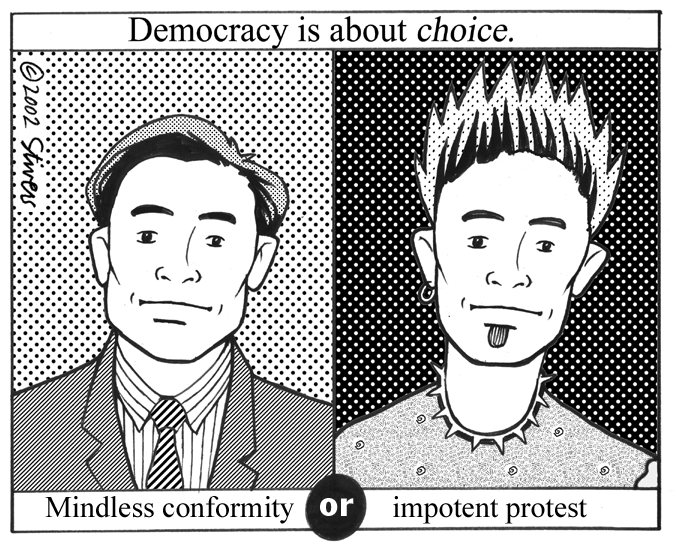
"No one pretends that democracy is perfect or all-wise. Indeed, it has been said that democracy is the worst form of government except all those other forms that have been tried from time to time."Democracy is a messy thing, and it makes mistakes.(Witness the repeated election of George W. Bush.) But when democratically-elected LSCs make mistakes in the selection of school principals, it is the children who ultimately suffer, and they don't have a vote. So it makes sense to me that the people with the ultimate authority for the effectiveness of the schools in Chicago (that is, the mayor and his appointed school board) should, in some cases, overrule the principal-selection decisions of the Local School Councils, not in order to curtail democracy, per se, but in order to do what's best for those poor kids. Democracy is, indeed, under siege in America these days, but we shouldn't use these kids as human shields in its defense.
Tuesday, February 16, 2010
Nonsense Fluency

My kindergarten daughter recently brought home her mid-year report card. Parts were easy to read – e.g. that she’s only “partially developed” in her ability to tie her shoelaces, but “well-developed” in her ability to count. Somewhat more baffling was the chart that showed her performance on the literacy measure known as the DIBELS, presented as graphs and percentiles and jargon. In the prosody, however, there were nuggets of poetry.
In the category of “nonsense fluency”, my daughter is “low risk”. What that technically means is that she did ok on a test that asked her to read 2 and 3 letter nonsense syllables. Although at first I was pleased to know that she’s a nonsense fluency low risk, as I read on I was slightly alarmed by the sense I could make of the tests and the language in which they were reported. My daughter was given a percentile ranking vis-à-vis her classmates, who were admitted into a selective kindergarten based on tests that ranked them vis-à-vis other city applicants. It seemed, well, nonsense to rank them against one another. After all, that means that some child in her class ranked down at 1%, even though he or she is probably reading much better than many other kindergarteners. More to the point, since no sensible child would bother with the numbers, that means that some poor parent opened up the report to find their child in the percentile basement – and what’s the sense of that?
Lately, I’ve been wondering what exactly it would mean to be at high risk of nonsense fluency. What about the boy who wrote a story about how he and his mother sat on a booby-trapped bench, on the day I volunteered and was put in charge of helping children write stories using “ch” words. “In the picture I drew, it was in 3-D”, he told me, “but I don’t have time to write that”. High risk of nonsense fluency, I suspect, and a good story. When she’s playing by herself, my daughter sometimes invents “fairy language”, to speak to the imaginary fairies she’s playing with. High risk, and delightful to overhear.
Being at a high risk of nonsense fluency myself, thanks to many years of education, I take the report card as a reminder to shut up sometimes. If you start making too much sense of nonsense, you put yourself at a high risk indeed.
Monday, February 1, 2010
Maxine Greene Tribute Now Online

The Journal of Educational Controversy is pleased to announce that the winter 2010 issue on “Arts, Social Imagination and Democratic Education” is now online. This issue is dedicated to the life and work of Maxine Greene.
We would like to draw the readers’ attention to an innovation that we introduced in this issue. In place of one of the printed articles, we are providing the reader a slide show of a child’s artistic drawings, with the author’s voice describing to the readers the significance of what they are viewing in the child’s work. The author traces the motifs found consistently in the child’s drawing over the course of several years so the reader/viewer can gain insight into the child’s imaginative communities, values, and dreams.
We invite readers to contribute formal refereed responses to our Rejoinder Section or more spontaneous responses on our journal’s blog.
Next Issue: The Role of Professionals in the Public Square
Future Issues:
The Education our Children Deserve
The Modern University in Turbulent Times
The School to Prison Pipeline
The Effect of Cultural Diversity on the Schools across the Globe: A Comparative Look
(Cross-posted on the Journal of Educational Controversy Blog)
Sunday, January 31, 2010
Teacher Motivations for Participation in Open Access Education
The Open Aceess Education movement is growing. Curricki, the open access curriculum wiki, now has over 80,000 curriculum units. (Hint to Dewey Scholars and other educational theorists: the section of Curricki devoted to foundations and research remains virgin territory, with only 12 entries as on the end of January 2010).Teachers can freely use, modify, or augment these units or mash them up into original courses.
Open access textbooks, sometimes misleadingly referred to as "open source" text books because they are published under GNU licenses, are becoming available for all grade levels and disciplines. All of these projects, like Linux and Wikipedia, depend on volunteer labor. Most of this labor is contributed by teachers.
Why do already over-worked teachers devote their spare time to producing open access products?
We think about teaching primarily as school teaching. This can make it hard to understand why teachers would want to contribute voluntarily to open access, or so-called ED 2.0, projects. But when we broaden our view of teaching we unlock this mystery.
School Teaching and Alienated Labor
A school is a formal organization structured along the traditional hierarchical framework of the firm. Whether public or private, a school involves the coordination of many teachers and staff members in order to get a job done.
Nominally this job is to deliver the curriculum, to cover the materials, to facilitate the achievement of learning goals. But as an organization, the job includes keeping the organization running, preventing conflicts from flaring into violence, preventing political blowback, protecting against law suits, and many other goals.
The hierarchical ordering of the school structure is needed in order to retain the flow of communications down from higher levels about what is to be done, and up from lower levels that the top-down requirements are being met. Many of the top down communications have nothing to do with the provision of educational value.
Teachers have some authority to structure their classrooms and plan lessons, but they are constrained, often severely, by decisions made at higher levels, decisions that are often counter-educational even if they protect the school as an organization. Often these constraints box teachers in; they feel hamstrung to act in knowing, creative and practically effective ways because they are forced to follow miseducative mandates. The best contemporary example is NCLB, which is reducing teaching to test prep. One recent Education Week article notes that 40% of teachers are now "disheartened". Another from Ed Week reports that top-down dictates, robbing them of professional autonomy, affect them even more negatively than poor working conditions or poorly prepared students.
Teaching is thus a prime example of what Karl Marx called "alienated labor". Teachers do their jobs even as their labor furthers ends contrary to their own own. In teaching, they nullify themselves as educators. Why do they do it? They need the money.
Teacher Motivations and Open Access Education or ED 2.0
Teachers working in schools may do it mostly because they need the money. But there is more to the story of why teachers teach.
Research shows that past a certain rather low point, more money does not make humans happier, and past another point, more money actually contributes to unhappiness. Teachers and other workers need enough money to live decent, respectable lives, and to feel they are being compensated fairly. Beyond this, money does not drive them, or most of the rest of us, very much.
Four other motivations become dominant as soon as we have established a financial basis for a dignified life, and play important roles even earlier.
1. The first is self-development, the need to continue to build upon our knowledge and skills, to get better at what we do, to actualize our human potentialities. Because the philosopher Aristotle made such a big deal about this, this is sometimes called the Aristotelian Principle.
2. The second is creativity or originality. One of the deepest human pleasures is to create, to see something beautiful or elegant come to life through our own efforts. The great psychologist Ernst Schachtel called the pleasure arising from our spontaneous self-activity "activity affect". Great teachers love to organize their classrooms as elegant spaces for learning and their lessons and units as aesthetic as well as practical achievements. Picasso said that he loved making art so much that he could not conceive of a life for himself that did not consist in making art most hours of every single day. Let's call this the "Picasso Principle".
3. The third is self-assertion or ego. All of us want to matter, want that our lives "make a difference". "Kilroy was here" says it all. The kid carving his initials on a tree says "I exist". This is an expression of the desire for recognition. The artist signing a picture, the author publishing a book, the teacher co-authoring a curriculum guide or textbook, is acting in accord with the "Kilroy Principle".
4. The fourth is the natural human desire to do good and coincidentally, to see oneself as good. There is a strong innate basis for empathy and pro-social behavior. And because humans are self-conscious, because we both are ourselves and see ourselves, are objects to ourselves as well as subjects of our experiences, we cannot fail to also judge ourselves using the same ethical categories we use to judge others. Despite our immense capacities for self-deception, we cannot not know what we know -- when we act against moral principles we apply to others we cannot entirely fail to judge ourselves and undermine our own sense of our moral goodness. Nothing is more harmful to our lives than this undermining of our own self-esteem. As a result, self-consciousness conduces to pro-social motivation. I will call this the Rescher Principle, because the philosopher Nicholas Rescher has explained it so clearly, even though it is found in philosophy since Plato. (See, for example, Rescher's Unselfishness: The Role of the Vicarious Affects in Moral Philosophy and Social Theory. Pittsburgh (University of Pittsburgh Press), 1975.)
Teaching and ED 2.0
The question now is why teachers would contribute to spontaneous voluntary self-organizing projects such as Curricki or Open Access Textbooks. The answer is this:
1. The Aristotelian Principle. Such contributions provide pathways alternative to conventional school teaching in which teachers can further develop unalientated knowledge and skills: in subject matter disciplines, in creative pedagogy, and in communications technology;
2. The Picasso Principle. Such contributions provide social, cultural and technological pathways for unalienated creative and elegant works: video courses, novel curricula, creative projects in children's literature, collaborative projects and many more;
3. The Kilroy Principle. Teachers are human. They want to feel they make a difference. Their alienated work in school often works against the sense that they matter; it nullifies their personal agency, subtracting them from their own classrooms. Their contributions to ED 2.0 projects, like those of the contributors to Linux code and Wikipedia, are concrete proofs of their existence and links to communities of mutual recognition;
4. The Rescher Principle. Most teachers are strongly motivated by the desire to be good and to see themselves as good. Participating in projects which improve the quality and diversity of learning experiences, reducing costs to poor children and poor districts (e.g., open source textbook projects, free video courses), connecting students with those from other social class and ethnic backgrounds, etc., are all opportunities to do good in concrete, visible, ways.
All of these motivations exist to different degrees in different humans, whether or not they work as professional teachers in schools. So we should not expect that every potential teacher-contributor will be motivated to join self-organizing educational communities. And we should also not expect anything approaching an equal contribution from those who join. My postulate is that like wikipedians, many people who use these resources will want to contribute something to them, and some few will devote themselves to it as a fundamental life commitment.
What motivates us to teach and to contribute to the profession? Please share your own motivations and observations.
Crossposted from The Ed 2.0 Report
Open access textbooks, sometimes misleadingly referred to as "open source" text books because they are published under GNU licenses, are becoming available for all grade levels and disciplines. All of these projects, like Linux and Wikipedia, depend on volunteer labor. Most of this labor is contributed by teachers.
Why do already over-worked teachers devote their spare time to producing open access products?
We think about teaching primarily as school teaching. This can make it hard to understand why teachers would want to contribute voluntarily to open access, or so-called ED 2.0, projects. But when we broaden our view of teaching we unlock this mystery.
School Teaching and Alienated Labor
A school is a formal organization structured along the traditional hierarchical framework of the firm. Whether public or private, a school involves the coordination of many teachers and staff members in order to get a job done.
Nominally this job is to deliver the curriculum, to cover the materials, to facilitate the achievement of learning goals. But as an organization, the job includes keeping the organization running, preventing conflicts from flaring into violence, preventing political blowback, protecting against law suits, and many other goals.
The hierarchical ordering of the school structure is needed in order to retain the flow of communications down from higher levels about what is to be done, and up from lower levels that the top-down requirements are being met. Many of the top down communications have nothing to do with the provision of educational value.
Teachers have some authority to structure their classrooms and plan lessons, but they are constrained, often severely, by decisions made at higher levels, decisions that are often counter-educational even if they protect the school as an organization. Often these constraints box teachers in; they feel hamstrung to act in knowing, creative and practically effective ways because they are forced to follow miseducative mandates. The best contemporary example is NCLB, which is reducing teaching to test prep. One recent Education Week article notes that 40% of teachers are now "disheartened". Another from Ed Week reports that top-down dictates, robbing them of professional autonomy, affect them even more negatively than poor working conditions or poorly prepared students.
Teaching is thus a prime example of what Karl Marx called "alienated labor". Teachers do their jobs even as their labor furthers ends contrary to their own own. In teaching, they nullify themselves as educators. Why do they do it? They need the money.
Teacher Motivations and Open Access Education or ED 2.0
Teachers working in schools may do it mostly because they need the money. But there is more to the story of why teachers teach.
Research shows that past a certain rather low point, more money does not make humans happier, and past another point, more money actually contributes to unhappiness. Teachers and other workers need enough money to live decent, respectable lives, and to feel they are being compensated fairly. Beyond this, money does not drive them, or most of the rest of us, very much.
Four other motivations become dominant as soon as we have established a financial basis for a dignified life, and play important roles even earlier.
1. The first is self-development, the need to continue to build upon our knowledge and skills, to get better at what we do, to actualize our human potentialities. Because the philosopher Aristotle made such a big deal about this, this is sometimes called the Aristotelian Principle.
2. The second is creativity or originality. One of the deepest human pleasures is to create, to see something beautiful or elegant come to life through our own efforts. The great psychologist Ernst Schachtel called the pleasure arising from our spontaneous self-activity "activity affect". Great teachers love to organize their classrooms as elegant spaces for learning and their lessons and units as aesthetic as well as practical achievements. Picasso said that he loved making art so much that he could not conceive of a life for himself that did not consist in making art most hours of every single day. Let's call this the "Picasso Principle".
3. The third is self-assertion or ego. All of us want to matter, want that our lives "make a difference". "Kilroy was here" says it all. The kid carving his initials on a tree says "I exist". This is an expression of the desire for recognition. The artist signing a picture, the author publishing a book, the teacher co-authoring a curriculum guide or textbook, is acting in accord with the "Kilroy Principle".
4. The fourth is the natural human desire to do good and coincidentally, to see oneself as good. There is a strong innate basis for empathy and pro-social behavior. And because humans are self-conscious, because we both are ourselves and see ourselves, are objects to ourselves as well as subjects of our experiences, we cannot fail to also judge ourselves using the same ethical categories we use to judge others. Despite our immense capacities for self-deception, we cannot not know what we know -- when we act against moral principles we apply to others we cannot entirely fail to judge ourselves and undermine our own sense of our moral goodness. Nothing is more harmful to our lives than this undermining of our own self-esteem. As a result, self-consciousness conduces to pro-social motivation. I will call this the Rescher Principle, because the philosopher Nicholas Rescher has explained it so clearly, even though it is found in philosophy since Plato. (See, for example, Rescher's Unselfishness: The Role of the Vicarious Affects in Moral Philosophy and Social Theory. Pittsburgh (University of Pittsburgh Press), 1975.)
Teaching and ED 2.0
The question now is why teachers would contribute to spontaneous voluntary self-organizing projects such as Curricki or Open Access Textbooks. The answer is this:
1. The Aristotelian Principle. Such contributions provide pathways alternative to conventional school teaching in which teachers can further develop unalientated knowledge and skills: in subject matter disciplines, in creative pedagogy, and in communications technology;
2. The Picasso Principle. Such contributions provide social, cultural and technological pathways for unalienated creative and elegant works: video courses, novel curricula, creative projects in children's literature, collaborative projects and many more;
3. The Kilroy Principle. Teachers are human. They want to feel they make a difference. Their alienated work in school often works against the sense that they matter; it nullifies their personal agency, subtracting them from their own classrooms. Their contributions to ED 2.0 projects, like those of the contributors to Linux code and Wikipedia, are concrete proofs of their existence and links to communities of mutual recognition;
4. The Rescher Principle. Most teachers are strongly motivated by the desire to be good and to see themselves as good. Participating in projects which improve the quality and diversity of learning experiences, reducing costs to poor children and poor districts (e.g., open source textbook projects, free video courses), connecting students with those from other social class and ethnic backgrounds, etc., are all opportunities to do good in concrete, visible, ways.
All of these motivations exist to different degrees in different humans, whether or not they work as professional teachers in schools. So we should not expect that every potential teacher-contributor will be motivated to join self-organizing educational communities. And we should also not expect anything approaching an equal contribution from those who join. My postulate is that like wikipedians, many people who use these resources will want to contribute something to them, and some few will devote themselves to it as a fundamental life commitment.
What motivates us to teach and to contribute to the profession? Please share your own motivations and observations.
Crossposted from The Ed 2.0 Report
Subscribe to:
Posts (Atom)