Saturday, September 13, 2008

Anti-Intellectualism in American (and Canadian) Life


I first read Richard Hofstadter’s Anti-Intellectualism in American Life a few years ago. My initial interest in the book stemmed from the fact that Hofstadter had accused Dewey of having unwittingly promulgated anti-intellectual trends in education. However, Hofstadter’s book has been on my mind lately because there is an epidemic of anti-intellectual discourse in the current American and Canadian election campaigns.

In the opening pages of the book, Hofstadter offers the following definition of anti-intellectualism:

“The common strain that binds together the attitudes and ideas which I call anti-intellectual is a resentment and suspicion of the life of he mind and of those who are considered to represent it; and a disposition constantly to minimize the value of that life.” (Hofstadter, pg. 7)

Readers of this blog who have been observing the American election probably already know that anti-intellectual rhetoric is playing a significant role in the campaign. For example, after the Obama campaign pointed out the number of houses McCain owned, McCain spokesman Brian Rogers offered the following statement: “"In terms of who's an elitist, I think people have made a judgment that John McCain is not an arugula-eating, pointy headed professor-type based on his life story." Notably, Hofstadter’s analysis informs us that this particular pattern of attack has a long history. During the campaign of 1800, attacks against Jefferson focused on his allegedly dangerous intellectual tendencies. Contemporary commentators argued that Jefferson’s “shewy talents” and dangerously French “theoretic learning” made him unfit for the presidency. Historian Charles Lerche commented on the effectiveness of this particular aspect of the campaign against Jefferson:

"Another persistent avenue of attack upon Jefferson was the charge that as a man given to abstract speculation he was automatically disqualified from holding the office of President. This was a shrewd strike, for the average American was (and is) profoundly suspicious of formal learning in politics, particularly when it is of a theoretical or speculative nature."

More than 200 years later, we are apparently in the “information age” and are participants in the “knowledge economy.” Yet despite this seeming valorization of knowledge, the anti-intellectual card is still just as powerful as ever, and politicians do not hesitate to play it.

Now, some American readers might be tempted to think that the Canadian political scene is too civilized to permit the brazen use of the anti-intellectual strategy. However, a recent web campaign by the Conservative Party of Canada has arguably gone farther down this road than any previous American efforts. Stéphane Dion, the current leader of the Liberal party of Canada, is a former professor at the Université de Montreal. Determined to use this fact to their advantage, the Conservative party has created a parody website, the main interface of which features “Professor Dion” standing in front of a blackboard, looking puzzled. The “Bio,” which is titled “From Professor to Weak Leader,” utilizes every available element of the anti-intellectual strategy. The text of the site reads as follows:

Dion has an unusual propensity to combine politics and pets. He named a turtle after the communist revolutionary Leon Trotsky. After the Liberals lost the 2006 election he bought a dog that he named after the environmental treaty, Kyoto, that he promised to implement as Environment Minister but failed to deliver on. He even once taught a parrot to say “ideology”.

Mr. Dion graduated from Université Laval with a B.A. in 1977 and an M.A. in 1979, both in political science. In 1986 he received his doctorate in sociology from the Institut d'études politiques in Paris.

Dion is especially proud of his educational background. He claimed in July 2008 that, if elected Prime Minister, he would be the first Prime Minister to hold a Ph.D. In fact Canada’s longest serving Prime Minister, William Lyon Mackenzie King, had a doctorate from Harvard University.

Professor Dion lectured at the Université de Moncton in 1984. He left Moncton after a few months, complaining that it lacked a certain je ne sais quoi, and went to the Université de Montréal where he taught from 1984 to 1996.

The various conclusions which we are meant to draw from this “bio” are (a) that Dion has dangerous radical tendencies, (b) that he is eccentric, (c) that he is unduly proud of his educational background, (d) that despite his intellectual pretensions, he is ignorant of Canadian history, and (e) that he is a snobby intellectual who would never be content with a small town like Moncton.

As an academic, I have to admit that these anti-intellectual attacks infuriate me. As an educator, however, I try to think somewhat more constructively; I wonder whether there is anything we can do to lessen the effectiveness of anti-intellectualism. In School and Society, Dewey spoke of knowledge becoming liquid, and he suggested that “a distinctively learned class is henceforth out of the question.” Needless to say, the continued potency of the anti-intellectual strategy indicates that this prophecy has not been entirely fulfilled. Perhaps this points to a need on the part of educators to redouble our efforts to demystify and to circulate our work. At any rate, I would certainly be interested to hear others’ thoughts about anti-intellectualism and what we can do about it.

Thursday, September 11, 2008

Obama's education politics

One of the better public press pieces I have read exploring the experiences that have shaped Barack Obama’s policy inclinations in regards to public education was published in the September 9th New York Times by Sam Dillon. It presents a portrait of Obama as deeply involved in Chicago public education reform, as a sincere inquirer into the complex problems of public education, and as committed to working out the problems of urban education, including the underachievement of children living in poverty.

http://www.nytimes.com/2008/09/10/us/politics/10educate.html?fta=y

All of these characteristics should endear him to pragmatists who adhere to Dewey’s legacy of strengthening the relationship between education and democracy. What is missing from Obama’s campaign rhetoric and what I would hope for from the office of the President, should he get elected, is that he use his bully pulpit to outline for the public the profoundly interrelated nature of school achievement, environmental safety, job security, public health, and other social concerns. I would like to see if a President could shift the discourse around school improvement to incorporate, in a way that is understandable to the general public, the brilliant analyses made by our colleagues such as David Berliner, Jonathon Kozol, and Jean Anyon, who have drawn this picture thoroughly and well for education scholars, but whose message has not quite made its way into the everyday understandings of people.

There are also some items on Obama’s education agenda that he might not have thought through as thoroughly as he needs to, items which, if taken as a whole present some serious contradictions. The position on merit pay, for example, is fraught with complications. He clearly understands the need for the very best teachers to be in high needs schools. However, if teachers are going to be financially rewarded on the basis of their students’ achievement, then there are few incentives to work in these high needs schools, where student achievement can be an elusive goal, especially in light of the holistic, interrelated nature of school achievement and the other social issues mentioned above.

Wednesday, September 3, 2008

first Youth Community Informatics Forum

In the Youth Community Informatics Forum held June 27-28, 2008, about 40 young people and youth leaders came to Champaign from a variety of economically disadvantaged, mostly minority communities throughout the state.

There was a youth media festival on Friday. Then on Saturday, participants spent the morning working in one of four small groups to investigate "information spaces" in the community. These included the Center for Children's Books, Champaign Public Library, the Independent Media Center, Espresso Royale, Native House, Cafe Paradiso, Transit Plaza, Illini Union, and bronze plaques around campus. The group leader introduced a staff member from the center to the students for a small tour and helped them use a Flip video camera and a GPS receiver to record their observations.

At each site, the youth asked questions such as:

  1. What do we see in this information center? How do we like it?

  2. What is this center about?

  3. What do we want people to know about the center?

  4. How can we give others a clear idea about the center through watching/hearing our report?


In the afternoon, they created a Google map with their videos, text, and GPS coordinates. They also added music (an innovation we hadn't planned on, but perfectly appropriate). They then shared their findings in a public presentation.

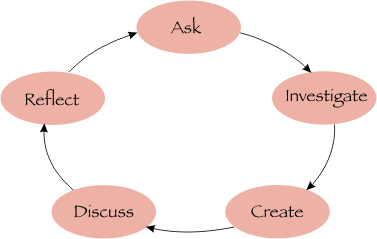
The activity was conceived in terms of an Inquiry Cycle:

Inquiry cycle

  • Ask: What are the information spaces in the community?

  • Investigate: Visit, listen, explore, video, determine geo-coordinates.

  • Create: Make a GIS site with video, music, text.

  • Discuss: Share the product and the findings with others.

  • Reflect: Think about issues of journalism, democracy, careers, technologies, etc.


We found that the students learned technology skills, problem solving, cooperative work, writing, public presentation, specific information spaces, community journalism, university life, and much more.

Although the June activity made use of diverse new technologies, it is important to note that the focus was on learning about the community, asking questions, and sharing findings with others, not on the technologies per se. The most effective use of these technologies in libraries and similar settings would likely involve embedding that use in a larger, purposeful context. That context in turn could be a way to help connect youth with other resources, such as books and structured activities.

We're now planning a similar activity in October with the Mortenson Center Associates, a group of visiting, international librarians. This will be the first day of a two- or three-day event. The longer time will allow for discussion about how the information spaces might differ in different countries, what technologies are available in different contexts, how valuable the activity would be for youth in their libraries, and so on. Students from the Community Informatics (LEEP) course would lead the investigation of the local-area information centers.

Both youth leaders and young people said they enjoyed the Forum, learned a lot, and hope for more. One youth leader said that next year he'd like to bring a much larger group. Another wrote,
I believe, in the not too distant future, that this conference will be seen as a landmark in developing a new perspective as part of the partnership between those marginalized sectors of civil society and the university in bridging the digital divide.

As Myles Horton might say, that's a long haul, but at least there was good spirit of cooperation in learning, which I hope will carry over to continuing work in these communities.

[Cross-posted on Chip's Journey]

Tuesday, September 2, 2008

Kwame Appiah on Social Identities, Identity Politics, and the Presidential Election


How are we to decide how to vote?

Should we study the policy positions of the candidates, determine to the best of our abilities which set of policies will have the best consequences for human well-being on the whole, and then vote for candidates supporting those policies?

Or should we consult with ourselves about which approaches to public problems best adhere to and symbolically express the social identities we find ourselves as possessing? For example, should we as men vote for the most manly candidate, or as women vote for a female candidate, or as African-Americans vote for an African-American candidate (or as a woman or African-American vote against a woman or African American candidate because he or she is not feminist or Black enough?)

Or, is it even possible to base our votes on rational consideration of consequences? And will we inevitably base our political decisions on our social identities?

And how have issues of social identity played a role in the primary battles between Hillary Clinton and Barack Obama, or between John McCain, Mitt Romney, and Mike Huckabee?

These issues are discussed in a fascinating 48 minute interview with Anthony Kwame Appiah, a Princeton philosopher and author of The Ethics of Identity and Cosmopolitanism: Ethics in a World of Strangers, who for the last 15 years has been among America's most interesting commentators on social and cultural issues.

GOP May Back Away from NCLB

Expect to hear no mention of NCLB at the Republican convention. Education Week reports that the GOP is split between support for federal accountibility measures and rejection of a strong federal role in education, a more traditional Republican party position. John McCain is not taking sides in this split.

“The biggest challenge within the Republican Party is really how much of a role should Washington continue to play,” said Eugene W. Hickok, who served as deputy secretary in the U.S. Department of Education earlier in President Bush’s tenure. Hickock, who was a tough policeman for NCLB, and who antagonized state officials trying to modify the strictures to fit their realities, said that "NCLB is a damaged brand."

GOP Education Platform Echoes McCain's Strong Conservative Proposals

The GOP has endorsed an education platform with many of the K-12 proposals of Sen. John McCain, Education Week reports today.

It calls for merit pay for teachers, for recruiting the best educators "without regard to collective bargaining agreements," for expanding charter schools and private school vouchers that can be used at religious schools.

McCain didn't mention NCLB in recent speeches and the GOP platform is just as vague; it doesn't mention the measure by name. But it calls for strong accountability measures.

The platform also supports "English First" instruction as opposed to bilingual education, and the right of students to engage in voluntary prayer in schools. The document also calls for replacing "family planning" programs for teenagers with increased funding for abstinence education.

Margaret Spellings Pleased with Failure to Re-Authorize NCLB

Interviewed at the GOP convention on Monday September 1, Secretary of Education Margaret Spellings says that she is happy that NCLB was not re-authorized this year, according to EdWeek. "Where we were headed would have been a bad reauthorization."

Her comments referred to the bill drafted by Rep. George Miller, D-Calif., the chairman of the House Education and Labor Committee, that would have permitted some states to use local assessments in their accountability systems, among other changes. She said that advocates of strong accountability would now have additional time to pass a new bill supporting the law's central principle of accountability.

While noting that education has taken a back seat in the presidential campaign, she sees that as a positive development, on the principle that "no news is good news". She said that Sen. John McCain would make a better education president, but also had kind words for Sen. Obama. "I think it was bold for him to speak out on merit pay. Let's see it happen."

Thursday, August 28, 2008

The Democratic Party Education Platform

The few remarks on education in Joe Biden's acceptance speech last night were lifted directly from pages 18-21 of the democratic election platform.

The education plank is brief and not very informative. The key features are recruiting and retaining teachers by providing merit pay, fixing NCLB by adding a number of additional metrics and providing resources for unsuccessful schools rather than labeling them as failures, supporting more public charter schools, and reforming schools of education. No details are provided in the platform itself. More detailed policy statements are no doubt available, but I haven't yet tracked them down.

Wednesday, August 27, 2008

Younger Democrats Moving Towards School Choice

At a democratic convention breakfast held by sponsors of school choice initiatives in Denver early this week, Colorado state Senate President Peter C. Groff noted that school choice demographics are changing, according to Ed Week's election campaign coverage.

Groff, 45, who is black, noted that African-American policymakers under the age of 50are no longer following in lock step behind teachers unions or party officials opposing school choice. "This is a generation that doesn't look at race first, but policy first," said Groff, 45, a Democrat. "It's not looking at party first, but the best idea first."

Newark Mayor Cory Booker, the event's main speaker, said charter schools in his New Jersey city are successful, but they don't have enough seats to fill demand.

Many Newark families "break the law, literally," said Booker, a Democrat. "They are faking addresses and sneaking [their children] into schools" in neighboring towns. School officials there investigate students and kick out those who live in Newark, charging their families tuition for the time they were enrolled.

"This is not the America I dream of," Booker said.

Tuesday, August 26, 2008

Academic Capitalism Watch I: Stanford Restricts Drug Marketing in Medical Education

Stanford University's program in medical continuing education will, according to the New York Times, announce today that it will no longer permit drug companies to pick and choose the continuing education courses they support. Going forward, any drug company wishing to support medical continuing education will contribute to a general pool. It can support the continuing education effort, but can no longer shape it to deliver its own carefully tailored marketing messages.

Dr. Philip A. Pizzo, dean of Stanford’s School of Medicine, said in an interview that the school wanted to take a firm stand on the issue, even if it meant that drug and device companies might no longer contribute to the educational effort if they could not specify which classes they wanted to support.

“I want to make sure we’re not marketing for industry or being influenced by their marketing,” Dr. Pizzo said.

The Times states that doctors have grown accustomed to getting their continuing education classes free and getting a nice lunch thrown in as an added inducement. "Separating commercial influences from doctor education might require doctors to pay their own way," the Times adds, "which some doctors have said they would resist."

You heard that! Feed me or you won't even be able to drag me to continuing education! How is that for entitlement? Corruption breeds corruption.

Dr. Murray Kopelow, chief executive of the Accreditation Council for Continuing Medical Education, said that Stanford’s new policy was part of a growing push in medical education to further separate crucial medical information from marketing messages.

“It’s a good plan, and it’s a big deal that a place like Stanford has adopted it,” Dr. Kopelow said. “When this is all over, medical education will not be the same as what it’s been.”

Actually, medical education may be taking a small step back to what it was until recently, an honest and professional attempt (not without its own biases, of course) to educate doctors and keep them up to speed.